0
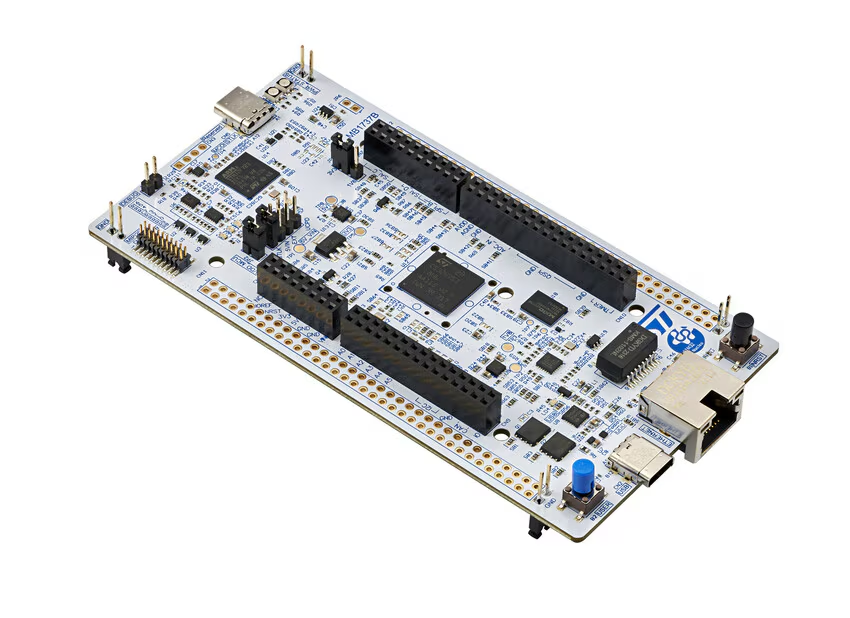
STM32 Nucleo-H743ZI Development Board
120,000 د.ع
Build high-performance embedded applications with the NUCLEO-H743ZI Development Board, a powerful evaluation platform from STMicroelectronics featuring the STM32H743ZI microcontroller. Part of the STM32 Nucleo-144 family, this board delivers exceptional processing power and advanced features, making it ideal for demanding applications in industrial control, motor drives, artificial intelligence, and high-speed data processing
Only 2 left in stock
CompareDescription
NUCLEO-H743ZI Development Board – STM32 Nucleo-144 with ARM Cortex-M7 High-Performance MCU
Build high-performance embedded applications with the NUCLEO-H743ZI Development Board, a powerful evaluation platform from STMicroelectronics featuring the STM32H743ZI microcontroller. Part of the STM32 Nucleo-144 family, this board delivers exceptional processing power and advanced features, making it ideal for demanding applications in industrial control, motor drives, artificial intelligence, and high-speed data processing.
The board is built around the STM32H743ZIT6 microcontroller, a 32-bit ARM Cortex-M7 processor with floating point unit (FPU) and Digital Signal Processing (DSP) instructions, running at up to 480 MHz. It offers 2 MB of flash memory and 1 MB of SRAM, providing ample resources for complex applications, large codebases, and data-intensive tasks. The microcontroller integrates a comprehensive set of peripherals including multiple USART, I2C, SPI interfaces, three 12-bit ADCs, two 12-bit DACs, USB OTG full-speed and high-speed, Ethernet MAC, and a variety of timers including advanced motor control timers.
A key feature of the NUCLEO-H743ZI is its integrated ST-LINK/V3 debugger/programmer, offering faster programming and debugging compared to previous versions. Simply connect the board to your computer via USB-C to program, debug, and power the board all through a single cable. The board supports multiple IDE options including IAR EWARM, Keil MDK, and STM32CubeIDE, with extensive software libraries and examples available through the STM32Cube software package.
The board features two types of expansion connectors: Arduino Uno V3 compatible headers allow you to use the vast ecosystem of Arduino shields, while ST Morpho headers provide full access to all STM32 I/O pins for maximum flexibility. With its high-performance core, extensive memory, and rich peripheral set, the NUCLEO-H743ZI is the ideal platform for advanced embedded systems, machine learning at the edge, and high-speed connectivity applications.
Key Features
STM32H743ZI High-Performance ARM Cortex-M7 Core
Powered by the STM32H743ZIT6 microcontroller featuring a 32-bit ARM Cortex-M7 processor with double-precision FPU and DSP instructions, running at up to 480 MHz, delivering exceptional computational performance for demanding applications.
Ample Memory Resources
Provides 2 MB of flash memory for program storage and 1 MB of SRAM, offering substantial capacity for complex applications, large firmware updates, and data-intensive tasks with flexible memory mapping.
Integrated ST-LINK/V3 Debugger/Programmer
Onboard ST-LINK/V3 debugger/programmer with SWD connector offers faster programming and debugging speeds. Supports USB re-enumeration for virtual COM port, mass storage, and debug port functionality.
Flexible Power Supply Options
Can be powered via USB-C or external sources including 3.3V, 5V, or 7-12V through the Arduino or Morpho connectors, with flexible power management access points.
Arduino Uno V3 Compatibility
Features Arduino Uno Revision 3 compatible headers, allowing you to use thousands of existing Arduino shields, sensors, and modules for rapid prototyping and expansion.
ST Morpho Extension Headers
Includes ST Morpho extension pin headers that provide full access to all STM32 I/O pins, enabling custom expansion and connection to specialized peripherals.
User and Reset Buttons
Provides two push buttons: a user-programmable button for application control and a reset button for system restart.
Three Onboard LEDs
Includes three LEDs: USB communication LED (LD1), user LED (LD2) for application status, and power LED (LD3) for board power indication.
Advanced Peripheral Support
Offers multiple USART, I2C, SPI interfaces, three 12-bit ADCs, two 12-bit DACs, USB OTG FS and HS, Ethernet MAC, CAN-FD, SAI audio interface, and advanced timers for motor control and power conversion.
Wide IDE Support
Compatible with IAR Embedded Workbench, Keil MDK, STM32CubeIDE, and GCC-based IDEs, with comprehensive software libraries and examples provided in the STM32Cube MCU software package.
Specifications
| Parameter | Value |
|---|---|
| Board Type | STM32 Nucleo-144 Development Board |
| Microcontroller | STM32H743ZIT6 |
| Core Architecture | ARM Cortex-M7 with DP-FPU and DSP |
| Clock Speed | Up to 480 MHz |
| Flash Memory | 2 MB |
| SRAM | 1 MB |
| Operating Voltage | 3.3V |
| Power Supply Options | USB-C, External 3.3V, 5V, or 7-12V |
| Digital I/O Pins | Up to 140 (through Morpho headers) |
| Analog Inputs | 3 x 12-bit ADC with up to 36 channels |
| Analog Outputs | 2 x 12-bit DAC |
| Communication Interfaces | USART (4+), I2C (4+), SPI (6+), USB OTG FS/HS, Ethernet MAC, CAN-FD |
| Timers | Advanced control, general-purpose, low-power, watchdog |
| Audio Interface | SAI (Serial Audio Interface) |
| Debugger | Integrated ST-LINK/V3 |
| Expansion | Arduino Uno V3, ST Morpho headers |
| User Interface | User button, Reset button, User LED (LD2) |
| Dimensions | Standard Nucleo-144 form factor |
Pin Configuration
Arduino Uno V3 Headers
The board includes Arduino Uno V3 compatible headers for easy shield compatibility:
| Header | Pins | Functions |
|---|---|---|
| Digital I/O | D0-D13 | Digital input/output, PWM, UART, SPI |
| Analog Input | A0-A5 | Analog-to-digital converter inputs |
| Power | 5V, 3.3V, GND, VIN | Power supply connections |
| ICSP | ICSP header | SPI programming interface |
ST Morpho Headers
The ST Morpho headers (CN7, CN10, CN11, CN12) provide full access to all STM32H743ZI I/O pins, including additional GPIO, ADC channels, DAC outputs, Ethernet, USB, and peripheral interfaces.
Wiring Diagram
Basic Power and Programming
USB-C Cable -----> Board USB-C Port
(Provides 5V power and programming/debugging via ST-LINK/V3)
Ethernet Connection
NUCLEO-H743ZI              Ethernet Network
---------------            ----------------
Ethernet RJ45   ----->     Ethernet Switch/Router
USB OTG Device Connection
NUCLEO-H743ZI              USB Device
---------------            ----------
USB Micro-B (CN13) ----->  Host Computer/Device
STM32CubeIDE Setup
-
Download and install STM32CubeIDE from STMicroelectronics website
-
Launch STM32CubeIDE and create a new STM32 project
-
Select the NUCLEO-H743ZI board from the board selector
-
Configure project settings and peripherals using the graphical pinout and clock configuration tools
-
Write your application code using HAL or LL libraries
-
Build and flash directly to the board via the integrated ST-LINK/V3
Arduino Code Example (Using Arduino IDE)
// Example: Blink User LED (LD2) and Read Analog Input

const int ledPin = LED_BUILTIN;  // LD2 is connected to PB13 on Nucleo-144
const int analogPin = A0;         // Analog input on Arduino header

void setup() {
  pinMode(ledPin, OUTPUT);
  Serial.begin(115200);
  Serial.println("NUCLEO-H743ZI High-Performance Ready");
}

void loop() {
  // Blink LED
  digitalWrite(ledPin, HIGH);
  delay(500);
  digitalWrite(ledPin, LOW);
  delay(500);

  // Read analog sensor value (12-bit ADC)
  int sensorValue = analogRead(analogPin);
  float voltage = (sensorValue / 4095.0) * 3.3;

  Serial.print("Analog Value: ");
  Serial.print(sensorValue);
  Serial.print("  Voltage: ");
  Serial.println(voltage, 3);
}
STM32CubeIDE Code Example (HAL Library)
/* USER CODE BEGIN 0 */
#define LED_PIN GPIO_PIN_13
#define LED_PORT GPIOB

void Error_Handler(void) {
  while(1) {
    HAL_GPIO_TogglePin(LED_PORT, LED_PIN);
    HAL_Delay(100);
  }
}
/* USER CODE END 0 */

int main(void) {
  HAL_Init();
  SystemClock_Config();
  MX_GPIO_Init();
  MX_USART3_UART_Init();

  char msg[] = "NUCLEO-H743ZI Running at 480MHz\r\n";
  HAL_UART_Transmit(&huart3, (uint8_t*)msg, strlen(msg), 100);

  while (1) {
    HAL_GPIO_TogglePin(LED_PORT, LED_PIN);
    HAL_Delay(500);
  }
}
Key Peripheral Highlights
High-Performance Core
-
480 MHz ARM Cortex-M7 with double-precision FPU
-
2 MB Flash with read-while-write capability
-
1 MB SRAM with TCM and cache for zero-wait execution
Rich Connectivity
-
Ethernet MAC with IEEE 1588 support
-
USB OTG Full-Speed and High-Speed
-
CAN-FD for automotive and industrial communication
-
SAI for high-quality audio applications
Advanced Analog
-
Three 12-bit ADCs with up to 3.6 MSPS
-
Two 12-bit DACs with output buffers
-
Digital filters for sigma-delta modulators
Security Features
-
Cryptographic acceleration (AES, SHA, RSA)
-
True random number generator (RNG)
-
Secure boot and flash protection
Common Applications
-
High-end industrial control systems
-
Motor drives and power conversion
-
Artificial intelligence and machine learning at the edge
-
High-speed data acquisition and processing
-
Networked IoT gateways
-
Advanced human-machine interfaces (HMI)
-
Audio processing and synthesis
-
Medical imaging and diagnostics
-
Automotive and transportation systems
-
Complex robotics and automation
Package Contents
-
1 x NUCLEO-H743ZI Development Board
لوحة تطوير NUCLEO-H743ZI – STM32 Nucleo-144 مع معالج ARM Cortex-M7 عالي الأداء
ابنِ تطبيقات مدمجة عالية الأداء باستخدام لوحة تطوير NUCLEO-H743ZI، وهي منصة تقييم قوية من STMicroelectronics تتميز بمتحكم STM32H743ZI. كجزء من عائلة STM32 Nucleo-144 الشهيرة، تقدم هذه اللوحة قدرة معالجة استثنائية وميزات متقدمة، مما يجعلها مثالية للتطبيقات المتطلبة في التحكم الصناعي ومحركات الدفع والذكاء الاصطناعي ومعالجة البيانات عالية السرعة.
تم بناء اللوحة حول متحكم STM32H743ZIT6، وهو معالج ARM Cortex-M7 32 بت مع وحدة فاصلة عائمة وتعليمات معالجة الإشارات الرقمية، يعمل بتردد يصل إلى 480 ميجاهرتز. يوفر 2 ميجابايت من ذاكرة الفلاش و 1 ميجابايت من ذاكرة الوصول العشوائي، مما يوفر موارد وفيرة للتطبيقات المعقدة وقواعد التعليمات البرمجية الكبيرة والمهام المكثفة للبيانات. يدمج المتحكم مجموعة شاملة من المحيطات بما في ذلك واجهات USART و I2C و SPI متعددة، وثلاثة محولات ADC 12 بت، ومحولي DAC 12 بت، ودعم USB OTG كامل السرعة وعالي السرعة، ووحدة تحكم Ethernet، ومجموعة متنوعة من المؤقتات بما في ذلك مؤقتات التحكم المتقدمة في المحركات.
الميزة الرئيسية للوحة NUCLEO-H743ZI هي مبرمج/مصحح ST-LINK/V3 المدمج، الذي يوفر برمجة وتصحيح أسرع مقارنة بالإصدارات السابقة. ما عليك سوى توصيل اللوحة بجهاز الكمبيوتر الخاص بك عبر USB-C لبرمجة وتصحيح وتشغيل اللوحة كل ذلك من خلال كابل واحد. تدعم اللوحة خيارات IDE متعددة بما في ذلك IAR EWARM و Keil MDK و STM32CubeIDE، مع مكتبات برمجية وأمثلة واسعة متوفرة عبر حزمة برامج STM32Cube.
تتميز اللوحة بنوعين من موصلات التوسعة: رؤوس متوافقة مع Arduino Uno V3 تسمح لك باستخدام النظام البيئي الواسع لدروع Arduino، بينما توفر رؤوس ST Morpho وصولاً كاملاً لجميع دبابيس الإدخال/الإخراج STM32 لأقصى مرونة. بفضل نواتها عالية الأداء وذاكرتها الواسعة ومجموعة المحيطات الغنية، تعتبر NUCLEO-H743ZI المنصة المثالية للأنظمة المدمجة المتقدمة والتعلم الآلي على الحافة وتطبيقات الاتصال عالية السرعة.
المميزات الرئيسية
معالج STM32H743ZI ARM Cortex-M7 عالي الأداء
مدعوم بمتحكم STM32H743ZIT6 الذي يتميز بمعالج ARM Cortex-M7 32 بت مع FPU مزدوج الدقة وتعليمات DSP، يعمل بتردد يصل إلى 480 ميجاهرتز، مما يوفر أداء حسابي استثنائي للتطبيقات المتطلبة.
موارد ذاكرة وفيرة
يوفر 2 ميجابايت من ذاكرة الفلاش لتخزين البرامج و 1 ميجابايت من ذاكرة الوصول العشوائي، مما يوفر سعة كبيرة للتطبيقات المعقدة وتحديثات البرامج الثابتة الكبيرة والمهام المكثفة للبيانات.
مبرمج/مصحح ST-LINK/V3 مدمج
مبرمج/مصحح ST-LINK/V3 مدمج مع موصل SWD يوفر سرعات برمجة وتصحيح أسرع. يدعم إعادة تعداد USB لمنفذ COM افتراضي وتخزين كبير ومنفذ تصحيح.
خيارات طاقة مرنة
يمكن تشغيلها عبر USB-C أو مصادر خارجية بما في ذلك 3.3V أو 5V أو 7-12V من خلال موصلات Arduino أو Morpho، مع نقاط وصول لإدارة الطاقة المرنة.
توافق مع Arduino Uno V3
تتميز برؤوس متوافقة مع Arduino Uno Revision 3، مما يسمح لك باستخدام آلاف الدروع وأجهزة الاستشعار والوحدات الحالية للنمذجة الأولية السريعة والتوسع.
رؤوس توسعة ST Morpho
تتضمن رؤوس توسعة ST Morpho التي توفر وصولاً كاملاً لجميع دبابيس الإدخال/الإخراج STM32، مما يتيح توسعة مخصصة والتوصيل بمحيطات متخصصة.
أزرار مستخدم وإعادة ضبط
توفر زرين ضغط: زر قابل للبرمجة للمستخدم للتحكم في التطبيق وزر إعادة ضبط لإعادة تشغيل النظام.
ثلاثة مصابيح LED مدمجة
تتضمن ثلاثة مصابيح LED: مصباح اتصال USB (LD1)، مصباح مستخدم (LD2) لحالة التطبيق، ومصباح طاقة (LD3) لتشغيل اللوحة.
دعم محيطي متقدم
يقدم واجهات USART و I2C و SPI متعددة، وثلاثة محولات ADC 12 بت، ومحولي DAC 12 بت، ودعم USB OTG كامل السرعة وعالي السرعة، ووحدة تحكم Ethernet، وواجهة SAI للصوت، ومؤقتات متقدمة للتحكم في المحركات وتحويل الطاقة.
دعم واسع لبيئات التطوير
متوافق مع IAR Embedded Workbench و Keil MDK و STM32CubeIDE وبيئات التطوير القائمة على GCC، مع مكتبات برمجية وأمثلة شاملة مقدمة في حزمة برامج STM32Cube.
المواصفات الفنية
| المعلمة | القيمة |
|---|---|
| نوع اللوحة | STM32 Nucleo-144 |
| المتحكم | STM32H743ZIT6 |
| بنية النواة | ARM Cortex-M7 مع FPU و DSP |
| تردد الساعة | حتى 480 ميجاهرتز |
| ذاكرة الفلاش | 2 ميجابايت |
| ذاكرة الوصول العشوائي | 1 ميجابايت |
| جهد التشغيل | 3.3V |
| خيارات الطاقة | USB-C، 3.3V خارجي، 5V، 7-12V |
| دبابيس الإدخال/الإخراج الرقمية | حتى 140 |
| المدخلات التماثلية | 3 × ADC 12 بت |
| المخرجات التماثلية | 2 × DAC 12 بت |
| واجهات الاتصال | USART (4+), I2C (4+), SPI (6+), USB OTG FS/HS, Ethernet, CAN-FD |
| واجهة الصوت | SAI |
| المصحح | ST-LINK/V3 مدمج |
| التوسعة | Arduino Uno V3، ST Morpho |
| واجهة المستخدم | زر مستخدم، زر إعادة ضبط، مصباح مستخدم |
| الأبعاد | عامل شكل Nucleo-144 القياسي |
التطبيقات الشائعة
-
أنظمة التحكم الصناعية المتطورة
-
محركات الدفع وتحويل الطاقة
-
الذكاء الاصطناعي والتعلم الآلي على الحافة
-
اكتساب ومعالجة البيانات عالية السرعة
-
بوابات إنترنت الأشياء المتصلة بالشبكة
-
واجهات الإنسان والآلة المتقدمة
-
معالجة الصوت وتوليد الإشارات
-
الأنظمة الطبية والتشخيص
-
الروبوتات والأتمتة المعقدة
محتويات العلبة
-
1 × لوحة تطوير NUCLEO-H743ZI

Reviews
There are no reviews yet.