0
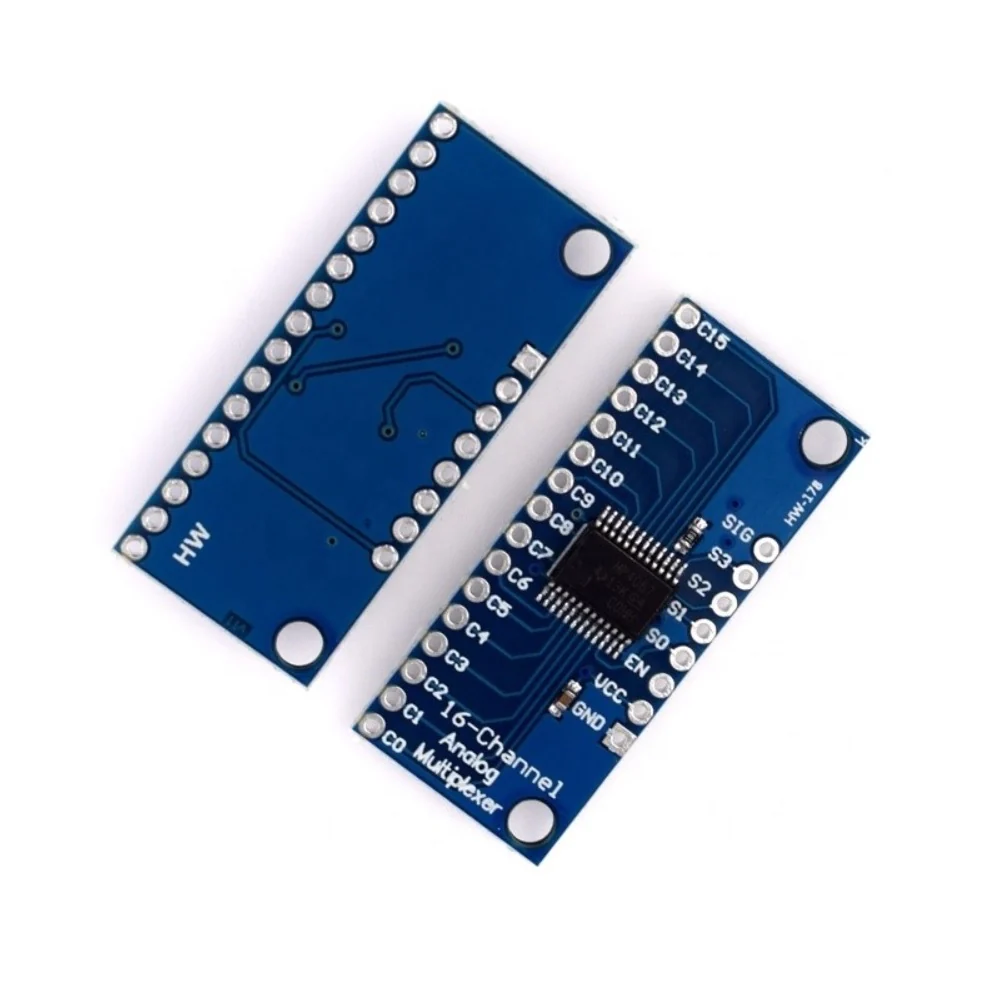
CD74HC4067 16-Channel Analog Multiplexer
2,500 د.ع
Expand the input/output capabilities of your microcontroller projects with this CD74HC4067 16-Channel Analog Multiplexer Module, a high-speed CMOS integrated circuit designed for efficient signal routing. This versatile component allows you to connect up to 16 analog or digital signals to a single microcontroller pin, dramatically increasing the number of sensors or devices your project can handle without requiring additional I/O pins .
In stock
CompareDescription
CD74HC4067 16-Channel Analog Multiplexer Module – High-Speed CMOS Analog/Digital Multiplexer
Expand the input/output capabilities of your microcontroller projects with this CD74HC4067 16-Channel Analog Multiplexer Module, a high-speed CMOS integrated circuit designed for efficient signal routing. This versatile component allows you to connect up to 16 analog or digital signals to a single microcontroller pin, dramatically increasing the number of sensors or devices your project can handle without requiring additional I/O pins .
The CD74HC4067 is a bidirectional 16:1 multiplexer/demultiplexer that can handle both analog and digital signals with equal ease. Using four digital select pins (S0-S3), you can independently choose which of the 16 channels (C0-C15) is connected to the common input/output pin (SIG). This makes it ideal for expanding analog sensor inputs, controlling multiple digital devices, or routing signals in audio and communication applications .
Built with high-speed CMOS technology, this multiplexer offers fast switching speeds and low power consumption, making it suitable for both battery-powered and performance-critical applications. The module typically includes onboard decoupling capacitors and pull-up resistors for stable operation, and comes in a convenient breakout board format with pin headers for easy breadboarding and integration with Arduino, ESP32, Raspberry Pi, and other microcontrollers .
Key Features
16-Channel Signal Expansion
Enables a single microcontroller pin to interface with up to 16 separate input or output channels. This is particularly valuable when you need to read multiple analog sensors but have limited ADC pins available on your microcontroller .
Bidirectional Operation
Functions as both a multiplexer (combining multiple inputs to one output) and a demultiplexer (routing one input to multiple outputs). The bidirectional design means any channel pin can be used as an input or output, and the common pin can serve as either .
Wide Voltage Compatibility
Operates from 2V to 6V DC, making it compatible with both 3.3V systems (Raspberry Pi, ESP32, STM32) and 5V systems (Arduino, PIC, AVR) without requiring level shifters .
Fast Switching Speed
Features high-speed CMOS technology with propagation delays as low as 10ns at 5V, allowing for rapid channel switching in time-critical applications .
Low ON Resistance
Typically 70Ω at 4.5V and 60Ω at 6V, ensuring minimal signal attenuation when routing analog signals. The low resistance helps maintain signal integrity across the multiplexer .
Simple 4-Pin Digital Control
Uses just four digital output pins to select any of the 16 channels. The binary address on S0-S3 determines the active channel, making control straightforward with any microcontroller .
Break-Before-Make Switching
Ensures that the connection to the previous channel is completely broken before the new channel is connected, preventing momentary short circuits between channels during switching .
Active-Low Enable Pin
Features an EN (enable) pin that, when pulled LOW, activates the device. When set HIGH, all switches are disabled, effectively disconnecting all channels and putting the module into a low-power state .
Wide Operating Temperature Range
Rated for -55°C to +125°C operation, suitable for industrial, automotive, and demanding environmental applications .
Specifications
| Parameter | Value |
|---|---|
| Part Number | CD74HC4067 |
| Configuration | 16-Channel Single-Ended Multiplexer/Demultiplexer |
| Supply Voltage (Vcc) | 2V to 6V DC |
| Input Voltage Range | 0V to Vcc |
| ON Resistance (RON) | 70Ω typical at 4.5V, 60Ω at 6V |
| Maximum Current per Pin | ±25mA |
| Propagation Delay | ~10ns at 5V |
| Switching Time | Fast, suitable for most analog and digital applications |
| Break-Before-Make Time | 6ns typical at 4.5V |
| Logic Family | High-Speed CMOS |
| Power Dissipation | 500mW (maximum) |
| Operating Temperature | -55°C to +125°C |
| Package Options | DIP-24, SOIC-24, TSSOP-24 (module uses breakout board with DIP-24 or surface-mount IC) |
| Module Interface | 2.54mm pin headers |
| Channel Pins | C0-C15 (16 channels) |
| Control Pins | S0-S3 (address selection), EN (enable), SIG (common I/O) |
Pin Configuration
| Module Pin | Function | Description |
|---|---|---|
| VCC | Power Supply | 2V to 6V DC positive supply |
| GND | Ground | Common ground |
| SIG | Signal Common | Common I/O pin (connects to selected channel) |
| EN | Enable | Active LOW enable (LOW = enabled, HIGH = all channels off) |
| S0 | Address Bit 0 | Channel selection (LSB) |
| S1 | Address Bit 1 | Channel selection |
| S2 | Address Bit 2 | Channel selection |
| S3 | Address Bit 3 | Channel selection (MSB) |
| C0-C15 | Channel Pins | 16 individual channel inputs/outputs |
Channel Selection Truth Table
| S3 | S2 | S1 | S0 | Active Channel | EN = LOW |
|---|---|---|---|---|---|
| 0 | 0 | 0 | 0 | Channel C0 | Connected |
| 0 | 0 | 0 | 1 | Channel C1 | Connected |
| 0 | 0 | 1 | 0 | Channel C2 | Connected |
| 0 | 0 | 1 | 1 | Channel C3 | Connected |
| 0 | 1 | 0 | 0 | Channel C4 | Connected |
| 0 | 1 | 0 | 1 | Channel C5 | Connected |
| 0 | 1 | 1 | 0 | Channel C6 | Connected |
| 0 | 1 | 1 | 1 | Channel C7 | Connected |
| 1 | 0 | 0 | 0 | Channel C8 | Connected |
| 1 | 0 | 0 | 1 | Channel C9 | Connected |
| 1 | 0 | 1 | 0 | Channel C10 | Connected |
| 1 | 0 | 1 | 1 | Channel C11 | Connected |
| 1 | 1 | 0 | 0 | Channel C12 | Connected |
| 1 | 1 | 0 | 1 | Channel C13 | Connected |
| 1 | 1 | 1 | 0 | Channel C14 | Connected |
| 1 | 1 | 1 | 1 | Channel C15 | Connected |
| X | X | X | X | All Channels | Disconnected (EN = HIGH) |
Arduino Wiring Diagram
CD74HC4067 Module          Arduino Uno
------------------          -----------
VCC                   ----->      5V
GND                   ----->      GND
S0                    ----->      Digital Pin 2
S1                    ----->      Digital Pin 3
S2                    ----->      Digital Pin 4
S3                    ----->      Digital Pin 5
SIG (Common)          ----->      Analog Pin A0
EN                    ----->      Digital Pin 6 (optional, or connect to GND)
Arduino Code Example
/*
 * CD74HC4067 16-Channel Analog Multiplexer Example
 * Reads all 16 analog channels and prints values to Serial Monitor
 */

// Define the select pins (S0-S3) connected to Arduino digital pins
const int selectPins[] = {2, 3, 4, 5};  // S0, S1, S2, S3
const int sigPin = A0;                   // SIG pin connected to analog input
const int enPin = 6;                     // EN pin (optional, connect to GND if not used)

void setup() {
  Serial.begin(9600);

  // Set select pins as outputs
  for (int i = 0; i < 4; i++) {
    pinMode(selectPins[i], OUTPUT);
    digitalWrite(selectPins[i], LOW);
  }

  // Set EN pin as output and enable the multiplexer (LOW = enabled)
  pinMode(enPin, OUTPUT);
  digitalWrite(enPin, LOW);  // Enable the multiplexer

  Serial.println("CD74HC4067 16-Channel Multiplexer Test");
  Serial.println("--------------------------------------");
}

void loop() {
  Serial.println("Reading all 16 channels:");

  for (int channel = 0; channel < 16; channel++) {
    // Set the address pins to select the current channel
    digitalWrite(selectPins[0], (channel & 1) ? HIGH : LOW);      // S0
    digitalWrite(selectPins[1], (channel & 2) ? HIGH : LOW);      // S1
    digitalWrite(selectPins[2], (channel & 4) ? HIGH : LOW);      // S2
    digitalWrite(selectPins[3], (channel & 8) ? HIGH : LOW);      // S3

    // Small delay to allow the multiplexer to settle
    delay(10);

    // Read the analog value from the selected channel
    int sensorValue = analogRead(sigPin);

    // Print the channel number and value
    Serial.print("Channel C");
    if (channel < 10) Serial.print("0");
    Serial.print(channel);
    Serial.print(": ");
    Serial.print(sensorValue);
    Serial.print(" (");

    // Convert to voltage (assuming 5V reference)
    float voltage = (sensorValue / 1023.0) * 5.0;
    Serial.print(voltage);
    Serial.println("V)");
  }

  Serial.println("--------------------------------------");
  delay(2000);  // Wait 2 seconds before next reading
}
Important Usage Notes
-
Enable Pin: The EN pin must be pulled LOW for normal operation. Connect to GND or a microcontroller pin set to LOW. When HIGH, all switches are turned off .
-
Power Supply: Use a stable power supply within the 2-6V range. Decoupling capacitors (0.1µF) near the VCC pin are recommended for noise reduction .
-
Voltage Limits: Ensure all input signals stay within the 0V to VCC range to prevent damage to the IC .
-
Channel Switching Delay: Allow a short settling time (typically 1-10ms) after changing channels before taking analog readings, especially when using sensors with high output impedance .
-
Multiple Modules: You can use multiple CD74HC4067 modules with the same select pins by connecting their SIG pins to different microcontroller ADC pins, or use separate select pins for independent control .
-
Break-Before-Make: The internal break-before-make switching ensures that channels never short together during transitions .
Common Applications
-
Expanding analog inputs for microcontrollers with limited ADC pins
-
Reading multiple temperature, humidity, or light sensors
-
Audio signal routing and mixing
-
Testing and measurement systems
-
Data acquisition systems
-
Industrial control and monitoring
-
Robotics sensor arrays
-
Home automation sensor networks
-
Educational electronics projects
-
Prototyping and development
Package Contents
-
1 x CD74HC4067 16-Channel Analog Multiplexer Module (breakout board)
وحدة مضاعف إشارة تماثلي 16 قناة CD74HC4067 – مضاعف إشارة تماثلي/رقمي CMOS عالي السرعة
وسع قدرات الإدخال/الإخراج لمشاريع المتحكمات الدقيقة الخاصة بك باستخدام وحدة مضاعف الإشارة التماثلية 16 قناة CD74HC4067، وهي دائرة متكاملة CMOS عالية السرعة مصممة لتوجيه الإشارات بكفاءة. يسمح لك هذا المكون متعدد الاستخدامات بتوصيل ما يصل إلى 16 إشارة تماثلية أو رقمية بدبوس متحكم دقيق واحد، مما يزيد بشكل كبير من عدد أجهزة الاستشعار أو الأجهزة التي يمكن لمشروعك التعامل معها دون الحاجة إلى دبابيس إدخال/إخراج إضافية .
يعتبر CD74HC4067 مضاعف/مزيل إشارة ثنائي الاتجاه 16:1 يمكنه التعامل مع كل من الإشارات التماثلية والرقمية بسهولة. باستخدام أربعة دبابيس اختيار رقمية، يمكنك اختيار أي من القنوات الـ 16 متصلة بدبوس الإدخال/الإخراج المشترك بشكل مستقل. هذا يجعله مثاليًا لتوسيع مدخلات أجهزة الاستشعار التماثلية أو التحكم في أجهزة رقمية متعددة أو توجيه الإشارات في تطبيقات الصوت والاتصالات .
بفضل تقنية CMOS عالية السرعة، يوفر هذا المضاعف سرعات تبديل سريعة واستهلاك طاقة منخفض، مما يجعله مناسبًا لكل من التطبيقات التي تعمل بالبطارية والتطبيقات الحرجة للأداء. تتضمن الوحدة عادةً مكثفات فصل ومقاومات سحب على متنها للتشغيل المستقر، وتأتي في تنسيق لوحة توصيل مريح مع رؤوس دبابيس لسهولة التركيب على لوحات التجارب والتكامل مع Arduino و ESP32 و Raspberry Pi والمتحكمات الدقيقة الأخرى .
المميزات الرئيسية
توسيع إشارة 16 قناة
تمكن دبوس متحكم دقيق واحد من التفاعل مع ما يصل إلى 16 قناة إدخال أو إخراج منفصلة. هذا ذو قيمة خاصة عندما تحتاج إلى قراءة أجهزة استشعار تماثلية متعددة ولكن لديك دبابيس ADC محدودة على متحكمك الدقيق .
تشغيل ثنائي الاتجاه
يعمل كمضاعف ومزيل إشارة. التصميم ثنائي الاتجاه يعني أنه يمكن استخدام أي دبوس قناة كمدخل أو مخرج، ويمكن للدبوس المشترك أن يعمل كأي منهما .
توافق جهد واسع
يعمل من 2 فولت إلى 6 فولت تيار مستمر، مما يجعله متوافقًا مع كل من أنظمة 3.3 فولت وأنظمة 5 فولت دون الحاجة إلى محولات مستوى .
سرعة تبديل سريعة
يتميز بتقنية CMOS عالية السرعة مع تأخيرات انتشار تصل إلى 10 نانو ثانية عند 5 فولت، مما يسمح بتبديل القنوات بسرعة في التطبيقات الحرجة للتوقيت .
مقاومة منخفضة عند التشغيل
نموذجياً 70 أوم عند 4.5 فولت و 60 أوم عند 6 فولت، مما يضمن الحد الأدنى من توهين الإشارة عند توجيه الإشارات التماثلية. تساعد المقاومة المنخفضة في الحفاظ على سلامة الإشارة عبر المضاعف .
تحكم رقمي بسيط بـ 4 دبابيس
يستخدم فقط أربعة دبابيس إخراج رقمية لاختيار أي من القنوات الـ 16. العنوان الثنائي على S0-S3 يحدد القناة النشطة، مما يجعل التحكم مباشرًا مع أي متحكم دقيق .
تبديل قبل الفصل
يضمن أن الاتصال بالقناة السابقة قد انقطع تمامًا قبل توصيل القناة الجديدة، مما يمنع الدوائر القصيرة اللحظية بين القنوات أثناء التبديل .
دبوس تمكين نشط منخفض
يتميز بدبوس EN الذي عند سحبه إلى LOW ينشط الجهاز. عند ضبطه على HIGH، يتم تعطيل جميع المفاتيح، مما يفصل جميع القنوات ويضع الوحدة في حالة طاقة منخفضة .
نطاق درجة حرارة تشغيل واسع
مصنف للتشغيل من -55 درجة مئوية إلى +125 درجة مئوية، مناسب للتطبيقات الصناعية والسيارات والبيئات الصعبة .
المواصفات الفنية
| المعلمة | القيمة |
|---|---|
| الرقم | CD74HC4067 |
| التكوين | مضاعف/مزيل إشارة 16 قناة |
| جهد التغذية | 2 فولت إلى 6 فولت تيار مستمر |
| نطاق جهد الإدخال | 0 فولت إلى Vcc |
| مقاومة التشغيل | 70 أوم نموذجي عند 4.5 فولت |
| أقصى تيار لكل دبوس | ±25 مللي أمبير |
| تأخير الانتشار | ~10 نانو ثانية عند 5 فولت |
| درجة حرارة التشغيل | -55 درجة مئوية إلى +125 درجة مئوية |
| دبابيس التحكم | S0-S3، EN، SIG |
| قنوات الإدخال/الإخراج | C0-C15 |
جدول اختيار القناة
| S3 | S2 | S1 | S0 | القناة النشطة |
|---|---|---|---|---|
| 0 | 0 | 0 | 0 | C0 |
| 0 | 0 | 0 | 1 | C1 |
| 0 | 0 | 1 | 0 | C2 |
| 0 | 0 | 1 | 1 | C3 |
| 0 | 1 | 0 | 0 | C4 |
| 0 | 1 | 0 | 1 | C5 |
| 0 | 1 | 1 | 0 | C6 |
| 0 | 1 | 1 | 1 | C7 |
| 1 | 0 | 0 | 0 | C8 |
| 1 | 0 | 0 | 1 | C9 |
| 1 | 0 | 1 | 0 | C10 |
| 1 | 0 | 1 | 1 | C11 |
| 1 | 1 | 0 | 0 | C12 |
| 1 | 1 | 0 | 1 | C13 |
| 1 | 1 | 1 | 0 | C14 |
| 1 | 1 | 1 | 1 | C15 |
ملاحظات استخدام مهمة
-
دبوس التمكين: يجب سحب دبوس EN إلى LOW للتشغيل العادي. قم بتوصيله بـ GND أو بدبوس متحكم دقيق مضبوط على LOW .
-
مصدر الطاقة: استخدم مصدر طاقة مستقر ضمن نطاق 2-6 فولت. يوصى باستخدام مكثفات فصل بالقرب من دبوس VCC لتقليل الضوضاء .
-
حدود الجهد: تأكد من بقاء جميع إشارات الإدخال ضمن نطاق 0V إلى Vcc لمنع تلف الدائرة المتكاملة .
-
تأخير تبديل القناة: اترك وقت استقرار قصير بعد تغيير القنوات قبل أخذ قراءات تماثلية .
التطبيقات الشائعة
-
توسيع المدخلات التماثلية للمتحكمات الدقيقة
-
قراءة أجهزة استشعار متعددة
-
توجيه الإشارات الصوتية
-
أنظمة اكتساب البيانات
-
مصفوفات استشعار الروبوتات
-
مشاريع الإلكترونيات التعليمية
محتويات العلبة
-
1 × وحدة مضاعف إشارة تماثلي CD74HC4067 16 قناة

Reviews
There are no reviews yet.