0
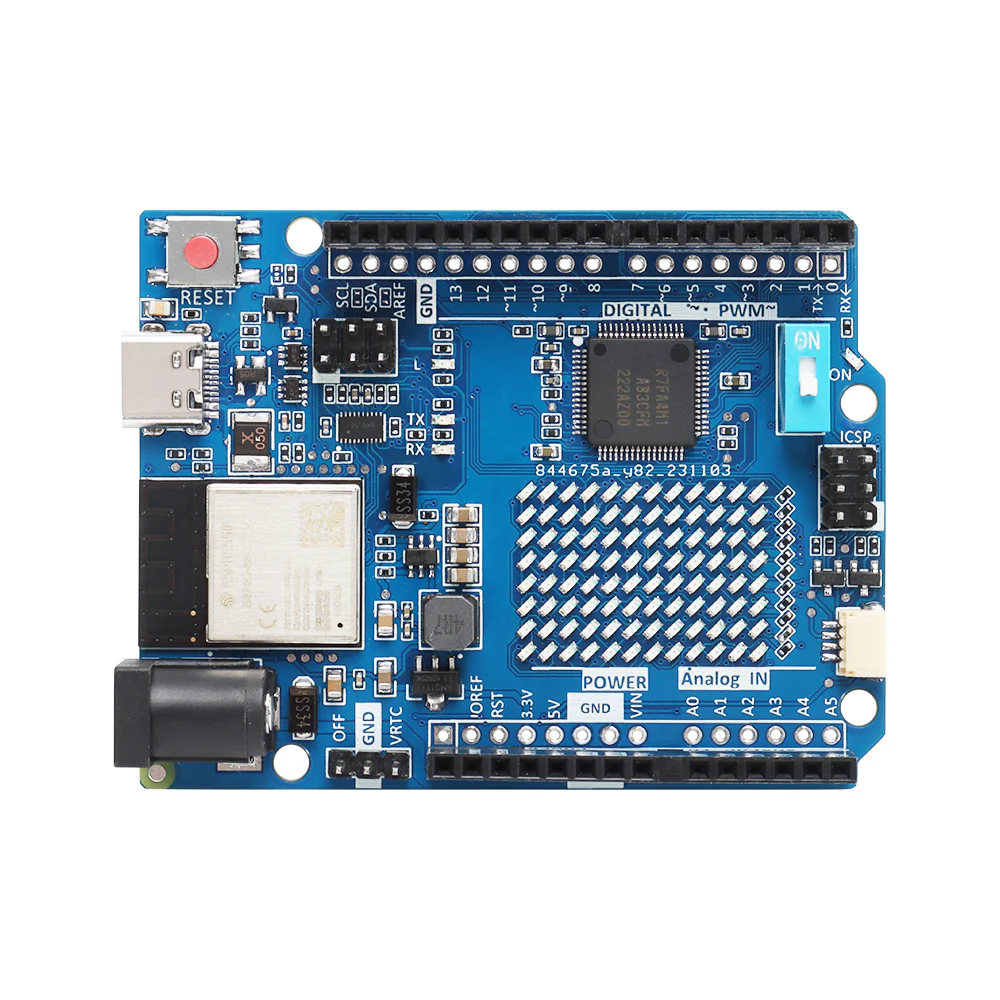
Arduino UNO R4 Minima WiFi Board
25,000 د.ع
Experience the next generation of the iconic Arduino platform with the Arduino UNO R4 Development Board, a powerful and modernized version of the classic UNO R3. This improved version retains the familiar form factor and 5V operating voltage for complete backward compatibility with existing shields and projects, while introducing a significant hardware upgrade to a 32-bit ARM Cortex-M4 architecture. Available in two variants—Minima and WiFi—this board caters to both budget-conscious makers and advanced IoT developers seeking integrated wireless connectivity.
In stock
CompareDescription
Arduino UNO R4 Minima / WiFi Development Control Board – Improved Version Compatible with Arduino Uno R4
Experience the next generation of the iconic Arduino platform with the Arduino UNO R4 Development Board, a powerful and modernized version of the classic UNO R3. This improved version retains the familiar form factor and 5V operating voltage for complete backward compatibility with existing shields and projects, while introducing a significant hardware upgrade to a 32-bit ARM Cortex-M4 architecture. Available in two variants—Minima and WiFi—this board caters to both budget-conscious makers and advanced IoT developers seeking integrated wireless connectivity.
The UNO R4 series is built around the Renesas RA4M1 microcontroller, running at 48 MHz—three times faster than the R3—and offers dramatically increased memory with 256KB of flash and 32KB of SRAM. This expanded memory and processing power allow for more complex projects, advanced sensor data processing, and smooth handling of large codebases without compromise.
For users who require wireless connectivity, the UNO R4 WiFi variant adds an ESP32-S3 coprocessor, providing native 2.4GHz Wi-Fi and Bluetooth 5.0 LE capabilities directly on the board. Additionally, it features an onboard 12×8 red LED matrix for visual output, a Qwiic I²C connector for easy sensor expansion, and integrated hardware debugging over USB. The Minima version offers the same core performance at a lower cost, ideal for projects that do not require wireless features.
Both boards feature a USB-C connector for programming and power, a wider input voltage range of 6-24V via the barrel jack, and enhanced onboard protection with Schottky diodes for overvoltage and reverse polarity protection. Whether you’re upgrading from an older Arduino, prototyping an IoT device, or teaching embedded systems, the UNO R4 family delivers a future-proof platform that combines classic simplicity with modern performance.
Key Features (Common to Both Versions)
Powerful 32-bit ARM Cortex-M4 Processor
Replaces the 8-bit AVR of the UNO R3 with a Renesas RA4M1 32-bit ARM Cortex-M4 processor running at 48MHz, delivering triple the clock speed and significantly improved computational efficiency for complex applications.
Expanded Memory
Offers 256KB of flash memory and 32KB of SRAM, providing eight times the program space and sixteen times the working memory of the R3, enabling larger sketches and more data-intensive projects.
5V Operating Voltage
Maintains 5V logic levels for complete compatibility with existing Arduino shields, sensors, and accessories, ensuring a seamless transition from older UNO boards.
Enhanced Power Management
Supports a wider input voltage range of 6V to 24V via the barrel jack, with improved thermal design and Schottky diodes for overvoltage and reverse polarity protection.
USB-C Connectivity
Features a modern USB-C port for programming, power, and HID functionality, allowing the board to emulate a keyboard or mouse directly connected to a host computer.
Upgraded Analog Capabilities
Includes a 12-bit DAC on pin A0 for true analog output, a 14-bit ADC, and an onboard operational amplifier, expanding possibilities for audio applications and analog signal processing.
Built-in CAN Bus
Integrates a CAN bus on pins D4 and D5, enabling communication in automotive and industrial control applications with an external transceiver.
Dual I²C and SPI Interfaces
Provides two I²C buses and two SPI buses, allowing more flexible peripheral connections and the ability to run multiple devices without bus conflicts.
Capacitive Touch Sensing
Features a Capacitive Touch Sensing Unit, enabling touch-based interfaces without additional hardware.
Enhanced Robustness
Designed with improved thermal behavior, protection diodes, and a sturdy construction to withstand challenging conditions and ensure long-term reliability.
Key Features (WiFi Version Only)
Integrated ESP32-S3 Coprocessor
Adds an Espressif ESP32-S3 module with dual-core 240MHz processor, handling all wireless communication independently from the main MCU.
2.4GHz Wi-Fi Connectivity
Supports 802.11 b/g/n Wi-Fi, enabling seamless internet connectivity for IoT applications, cloud services, and remote monitoring.
Bluetooth 5.0 Low Energy
Integrated Bluetooth 5.0 LE allows wireless connection to smartphones, tablets, and other BLE peripherals for data logging, configuration, and remote control.
12×8 Onboard LED Matrix
Features 96 individually addressable red LEDs arranged in a grid, controlled via the Arduino_LED_Matrix library. A dedicated web-based tool allows easy creation and export of custom animations.
Qwiic I²C Connector
Includes a Qwiic-style connector for plug-and-play connection to a growing ecosystem of I²C sensors and modules, eliminating the need for soldering or jumper wires.
Hardware Debugging via USB
Enables integrated debugging over USB without external programmers, with a built-in error-catching mechanism that outputs detailed stack traces when the code crashes.
RTC with Battery Backup
Real-time clock with optional battery backup via the VRTC pin, allowing timekeeping even when main power is disconnected.
Specifications Comparison
| Parameter | UNO R4 Minima | UNO R4 WiFi |
|---|---|---|
| Microcontroller (Main) | Renesas RA4M1 (ARM Cortex-M4) | Renesas RA4M1 (ARM Cortex-M4) |
| Clock Speed | 48 MHz | 48 MHz |
| Flash Memory | 256 KB | 256 KB |
| SRAM | 32 KB | 32 KB |
| Operating Voltage | 5V | 5V |
| Input Voltage (VIN) | 6-24V | 6-24V |
| Digital I/O Pins | 14 (6 PWM) | 14 (6 PWM) |
| Analog Input Pins | 6 (14-bit ADC) | 6 (14-bit ADC) |
| DAC | 12-bit (on A0) | 12-bit (on A0) |
| I²C Interfaces | 2 | 2 |
| SPI Interfaces | 2 | 2 |
| UART | 1 | 1 |
| CAN Bus | Yes | Yes |
| Operational Amplifier | Yes | Yes |
| Wireless Connectivity | None | 2.4GHz Wi-Fi, Bluetooth 5.0 LE |
| LED Matrix | None | 12×8 (96 red LEDs) |
| Qwiic Connector | No | Yes |
| RTC with Battery Backup | No | Yes |
| USB Connector | USB-C | USB-C |
| Dimensions | 68.9mm x 53.4mm | 68.9mm x 53.4mm |
Pin Configuration
| Pin Category | Pins | Function |
|---|---|---|
| Digital I/O | D0-D13 | 14 digital pins, PWM on D3, D5, D6, D9, D10, D11 |
| Analog Inputs | A0-A5 | 6 analog input pins (14-bit ADC) |
| DAC Output | A0 | 12-bit true analog output |
| UART | D0 (RX), D1 (TX) | Hardware serial communication |
| SPI | D10-D13, ICSP header | SPI interface |
| I²C (Primary) | A4 (SDA), A5 (SCL) | I²C bus |
| I²C (Secondary) | D14 (SDA), D15 (SCL) | Additional I²C bus (WiFi version) |
| CAN Bus | D4, D5 | CAN interface (requires external transceiver) |
| Power | VIN, 5V, 3.3V, GND | Power supply and ground |
Wiring Diagram
Basic Setup
USB-C Cable -----> Board USB-C Port
(Provides power and programming)

Or External Power:
6-24V DC ----> VIN pin
GND --------> GND pin
Connecting a Sensor (I²C Example)
UNO R4                     I²C Sensor
-------                    ----------
3.3V or 5V   ----------->  VCC
GND          ----------->  GND
A4 (SDA)     ----------->  SDA
A5 (SCL)     ----------->  SCL
Arduino Code Example
// Example: Blink LED and Read Sensor Data
#define LED_PIN 13

void setup() {
  Serial.begin(9600);
  pinMode(LED_PIN, OUTPUT);
  Serial.println("UNO R4 Ready");
}

void loop() {
  // Blink the built-in LED
  digitalWrite(LED_PIN, HIGH);
  delay(500);
  digitalWrite(LED_PIN, LOW);
  delay(500);

  Serial.print("Free Memory: ");
  Serial.println(ESP.getFreeHeap()); // For WiFi version
  delay(2000);
}
Common Applications
-
IoT devices and wireless sensor networks
-
Robotics and automation control
-
Home automation and smart lighting
-
Data logging and environmental monitoring
-
Educational platforms and STEM learning
-
Industrial control and CAN bus communication
-
Audio synthesis and analog signal processing
-
Prototyping and product development
Package Contents
-
1 x Arduino UNO R4 Development Board (selected variant: Minima or WiFi)
لوحة تطوير وتحكم Arduino UNO R4 Minima / WiFi – نسخة محسنة متوافقة مع Arduino Uno R4
اختبر الجيل التالي من منصة Arduino الأيقونية مع لوحة تطوير Arduino UNO R4، وهي نسخة قوية ومحدثة من UNO R3 الكلاسيكية. تحتفظ هذه النسخة المحسنة بعامل الشكل المألوف وجهد التشغيل 5 فولت للتوافق الكامل مع الدروع والمشاريع الحالية، مع إدخال ترقية كبيرة للأجهزة إلى بنية ARM Cortex-M4 32 بت. متوفرة في نسختين – Minima و WiFi – تلبي هذه اللوحة احتياجات كل من المبتدئين المهتمين بالميزانية والمطورين المتقدمين في إنترنت الأشياء الذين يبحثون عن اتصال لاسلكي متكامل .
تم بناء سلسلة UNO R4 حول متحكم Renesas RA4M1، الذي يعمل بتردد 48 ميجاهرتز – أسرع بثلاث مرات من R3 – ويوفر ذاكرة متزايدة بشكل كبير مع 256 كيلوبايت من ذاكرة الفلاش و 32 كيلوبايت من ذاكرة الوصول العشوائي. تسمح هذه الذاكرة الموسعة وقوة المعالجة بمشاريع أكثر تعقيدًا ومعالجة بيانات استشعار متقدمة والتعامل السلس مع قواعد التعليمات البرمجية الكبيرة دون تنازلات .
بالنسبة للمستخدمين الذين يحتاجون إلى اتصال لاسلكي، تضيف نسخة UNO R4 WiFi معالجًا مساعدًا ESP32-S3، مما يوفر إمكانيات Wi-Fi 2.4 جيجاهرتز و Bluetooth 5.0 LE مباشرة على اللوحة. بالإضافة إلى ذلك، تتميز بمصفوفة LED حمراء 12×8 على متنها للإخراج المرئي، وموصل Qwiic I²C لتوسعة سهلة لأجهزة الاستشعار، وتصحيح أخطاء الأجهزة المدمج عبر USB. تقدم نسخة Minima نفس الأداء الأساسي بتكلفة أقل، مثالية للمشاريع التي لا تتطلب ميزات لاسلكية .
تتميز كلتا اللوحتين بموصل USB-C للبرمجة والطاقة، ونطاق جهد إدخال أوسع 6-24 فولت عبر مقبس البرميل، وحماية محسنة على متنها مع ثنائيات شوتكي للحماية من الجهد الزائد وعكس القطبية . سواء كنت تقوم بالترقية من Arduino قديم أو تصمم نموذجًا أوليًا لجهاز إنترنت الأشياء أو تدرس الأنظمة المدمجة، فإن عائلة UNO R4 تقدم منصة مقاومة للمستقبل تجمع بين البساطة الكلاسيكية والأداء الحديث .
المميزات الرئيسية (المشتركة بين النسختين)
معالج ARM Cortex-M4 32 بت القوي
يحل محل معالج AVR 8 بت لـ UNO R3 بمعالج Renesas RA4M1 32 بت ARM Cortex-M4 يعمل بتردد 48 ميجاهرتز، مما يوفر ثلاثة أضعاف سرعة الساعة وتحسينًا كبيرًا في الكفاءة الحسابية للتطبيقات المعقدة .
ذاكرة موسعة
يوفر 256 كيلوبايت من ذاكرة الفلاش و 32 كيلوبايت من ذاكرة الوصول العشوائي، مما يوفر ثمانية أضعاف مساحة البرنامج وستة عشر ضعفًا من ذاكرة العمل مقارنة بـ R3، مما يتيح رسومات أكبر ومشاريع أكثر كثافة في البيانات .
جهد تشغيل 5 فولت
يحافظ على مستويات منطق 5 فولت للتوافق الكامل مع دروع Arduino الحالية وأجهزة الاستشعار والملحقات، مما يضمن انتقالًا سلسًا من لوحات UNO القديمة .
إدارة طاقة محسنة
يدعم نطاق جهد إدخال أوسع من 6 فولت إلى 24 فولت عبر مقبس البرميل، مع تصميم حراري محسن وثنائيات شوتكي للحماية من الجهد الزائد وعكس القطبية .
اتصال USB-C
يتميز بمنفذ USB-C حديث للبرمجة والطاقة ووظائف HID، مما يسمح للوحة بمحاكاة لوحة مفاتيح أو ماوس متصل مباشرة بجهاز كمبيوتر مضيف .
قدرات تناظرية مطورة
يتضمن محول DAC 12 بت على دبوس A0 لإخراج تناظري حقيقي، ومحول ADC 14 بت، ومضخم عملياتي على متنها، مما يوسع إمكانيات تطبيقات الصوت ومعالجة الإشارات التناظرية .
ناقل CAN مدمج
يدمج ناقل CAN على الدبابيس D4 و D5، مما يتيح الاتصال في تطبيقات التحكم في السيارات والصناعية مع مرسل خارجي .
واجهات I²C و SPI مزدوجة
يوفر ناقلين I²C وناقلين SPI، مما يسمح بتوصيلات محيطية أكثر مرونة والقدرة على تشغيل أجهزة متعددة بدون تعارض في الناقل .
استشعار سعوي باللمس
يتميز بوحدة استشعار سعوي باللمس، مما يتيح واجهات تعمل باللمس بدون أجهزة إضافية .
متانة محسنة
مصمم بسلوك حراري محسن وثنائيات حماية وهيكل قوي لتحمل الظروف الصعبة وضمان موثوقية طويلة الأمد .
المميزات الرئيسية (نسخة WiFi فقط)
معالج مساعد ESP32-S3 مدمج
يضيف وحدة Espressif ESP32-S3 مع معالج ثنائي النواة بتردد 240 ميجاهرتز، يتعامل مع جميع الاتصالات اللاسلكية بشكل مستقل عن MCU الرئيسي .
اتصال Wi-Fi 2.4 جيجاهرتز
يدعم Wi-Fi 802.11 b/g/n، مما يتيح اتصالاً سلسًا بالإنترنت لتطبيقات إنترنت الأشياء والخدمات السحابية والمراقبة عن بُعد .
Bluetooth 5.0 Low Energy
يسمح Bluetooth 5.0 LE المدمج بالاتصال اللاسلكي بالهواتف الذكية والأجهزة اللوحية والأجهزة الطرفية الأخرى لتسجيل البيانات والتكوين والتحكم عن بُعد .
مصفوفة LED 12×8 على متنها
يتميز بـ 96 مصباح LED أحمر قابل للعنونة الفردية مرتبة في شبكة، يتم التحكم فيها عبر مكتبة Arduino_LED_Matrix. تسمح أداة ويب مخصصة بإنشاء وتصدير الرسوم المتحركة المخصصة بسهولة .
موصل Qwiic I²C
يتضمن موصلًا من نوع Qwiic لتوصيل سهل لعدد متزايد من أجهزة الاستشعار والوحدات I²C، مما يلغي الحاجة إلى اللحام أو أسلاك التوصيل .
تصحيح أخطاء الأجهزة عبر USB
يتيح تصحيح أخطاء مدمج عبر USB بدون مبرمجين خارجيين، مع آلية مدمجة للقبض على الأخطاء تخرج تتبع المكدس التفصيلي عند تعطل الكود .
ساعة زمن حقيقي مع بطارية احتياطية
ساعة زمن حقيقي مع بطارية احتياطية اختيارية عبر دبوس VRTC، مما يسمح بالحفاظ على الوقت حتى عند فصل الطاقة الرئيسية .
مقارنة المواصفات
| المعلمة | UNO R4 Minima | UNO R4 WiFi |
|---|---|---|
| المتحكم (الرئيسي) | Renesas RA4M1 | Renesas RA4M1 |
| تردد الساعة | 48 ميجاهرتز | 48 ميجاهرتز |
| ذاكرة الفلاش | 256 كيلوبايت | 256 كيلوبايت |
| ذاكرة الوصول العشوائي | 32 كيلوبايت | 32 كيلوبايت |
| جهد التشغيل | 5 فولت | 5 فولت |
| جهد الدخل | 6-24 فولت | 6-24 فولت |
| دبابيس الإدخال/الإخراج | 14 | 14 |
| مدخلات تماثلية | 6 | 6 |
| مخرج DAC | 12 بت | 12 بت |
| الاتصال اللاسلكي | لا | Wi-Fi، Bluetooth |
| مصفوفة LED | لا | 12×8 |
| موصل Qwiic | لا | نعم |
| موصل USB | USB-C | USB-C |
التطبيقات الشائعة
-
أجهزة إنترنت الأشياء وشبكات الاستشعار اللاسلكية
-
الروبوتات والتحكم في الأتمتة
-
أتمتة المنزل والإضاءة الذكية
-
تسجيل البيانات والمراقبة البيئية
-
المنصات التعليمية وتعلم STEM
-
التحكم الصناعي واتصالات CAN bus
-
تركيب الصوت ومعالجة الإشارات التناظرية
-
النمذجة الأولية وتطوير المنتجات
محتويات العلبة
-
1 × لوحة تطوير Arduino UNO R4 (النسخة المختارة: Minima أو WiFi)


Reviews
There are no reviews yet