0
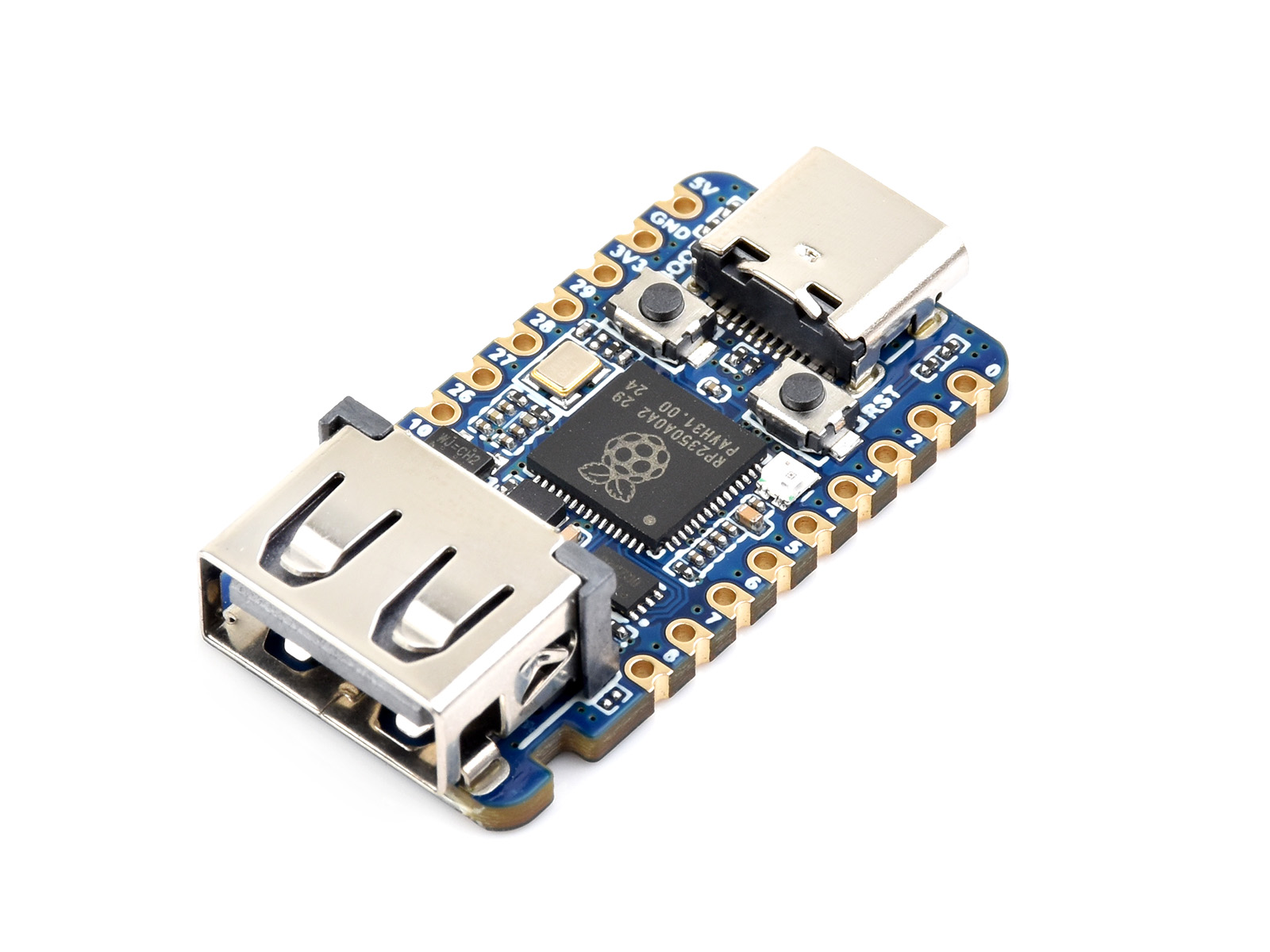
RP2350 USB-A Mini Development Board
13,000 د.ع
Build powerful, high-performance embedded projects with the RP2350 USB-A Mini Development Board, a compact yet feature-rich microcontroller module based on the Raspberry Pi RP2350 chip. This innovative board features a unique dual-core, dual-architecture design, combining ARM Cortex-M33 and RISC-V Hazard3 cores, both running at up to 150 MHz. Whether you’re developing USB peripherals, real-time sensor systems, or learning embedded programming, this board offers exceptional flexibility and performance in an ultra-compact form factor.
In stock
CompareDescription
RP2350 USB-A Mini Development Board – Compact Dual-Core Microcontroller Module with USB Host Port
Build powerful, high-performance embedded projects with the RP2350 USB-A Mini Development Board, a compact yet feature-rich microcontroller module based on the Raspberry Pi RP2350 chip. This innovative board features a unique dual-core, dual-architecture design, combining ARM Cortex-M33 and RISC-V Hazard3 cores, both running at up to 150 MHz. Whether you’re developing USB peripherals, real-time sensor systems, or learning embedded programming, this board offers exceptional flexibility and performance in an ultra-compact form factor.
Key Features
Dual-Core Dual-Architecture Processor
Powered by the Raspberry Pi RP2350 chip, featuring dual-core ARM Cortex-M33 processor and dual-core Hazard3 RISC-V core processor (total 4 cores), running at up to 150 MHz. This unique architecture allows you to choose between ARM and RISC-V environments, switching cores based on workload or software ecosystem needs.
Onboard USB-A Host Port
Features a standard USB Type-A port connected to GPIO12 and GPIO13 via a PIO-USB implementation, enabling direct connection to USB peripherals such as keyboards, mice, USB-to-serial adapters, and BLE dongles without additional hardware. This makes it ideal for USB host applications and custom HID devices.
Native USB-C Programming Port
Includes a USB Type-C port for power and programming, supporting drag-and-drop UF2 file uploads via mass storage. Simply hold the BOOT button, connect to your computer, and drag the firmware file to the RPI-RP2 drive.
Dual USB Connectivity
The board offers two USB ports – one Type-C for programming and power, and one Type-A for USB host functionality. This allows simultaneous device programming and USB peripheral connection.
Ample Memory Resources
Built-in 520KB of SRAM and 2MB of on-chip Flash memory, providing sufficient capacity for complex applications, real-time data processing, and firmware storage.
15 Multifunctional GPIO Pins
All 15 GPIO pins of the RP2350 are broken out via 2.54mm pitch headers, supporting multiple hardware peripherals including 2x SPI, 2x I2C, 2x UART, 4x 12-bit ADC channels, and 14 controllable PWM channels.
Programmable I/O (PIO) State Machines
Features 12 programmable I/O (PIO) state machines for custom peripheral support, enabling implementation of specialized interfaces like the PIO-USB host functionality.
Compact Form Factor
Measures approximately 33mm x 17.5mm, with castellated edges (half-hole technology) allowing direct soldering onto carrier boards for permanent integration into custom designs.
Onboard WS2812 RGB LED
Includes a programmable WS2812 RGB LED connected to GPIO16, providing visual status indication and creative lighting effects for your projects.
Low-Power Modes
Supports sleep and dormant modes, making the board suitable for battery-powered and energy-sensitive applications.
Easy Drag-and-Drop Programming
Supports mass storage over USB for simple firmware updates. No special programmers or software required – just drag and drop your UF2 file.
Specifications
| Parameter | Value |
|---|---|
| Microcontroller | Raspberry Pi RP2350A |
| Processor Cores | 2x ARM Cortex-M33 + 2x Hazard3 RISC-V |
| Clock Speed | Up to 150 MHz |
| SRAM | 520 KB |
| Flash Memory | 2 MB (on-chip) |
| GPIO Pins | 15 |
| USB Ports | 1x USB-C (programming/power), 1x USB-A (host) |
| PIO State Machines | 12 |
| SPI | 2 |
| I2C | 2 |
| UART | 2 |
| ADC Channels | 4 (12-bit) |
| PWM Channels | 14 |
| RGB LED | WS2812 (GPIO16) |
| User Buttons | BOOT, RESET |
| Mounting | Castellated edges for SMT |
| Dimensions | 33mm x 17.5mm |
| Power Supply | 5V via USB-C |
| Programming | UF2 drag-and-drop, SWD debug |
Pin Configuration
| Pin | Function | Pin | Function |
|---|---|---|---|
| GP0 | UART0 TX / I2C0 SDA | GP8 | SPI1 RX / I2C1 SDA |
| GP1 | UART0 RX / I2C0 SCL | GP9 | SPI1 CS / I2C1 SCL |
| GP2 | SPI0 SCK / I2C1 SDA | GP10 | SPI1 SCK / PWM |
| GP3 | SPI0 TX / I2C1 SCL | GP11 | SPI1 TX / PWM |
| GP4 | SPI0 RX / I2C0 SDA | GP12 | USB-A D- (PIO) |
| GP5 | SPI0 CS / I2C0 SCL | GP13 | USB-A D+ (PIO) |
| GP6 | SPI1 RX / I2C0 SDA | GP14 | PWM / GPIO |
| GP7 | SPI1 TX / I2C0 SCL | GP15 | PWM / GPIO |
| GP16 | WS2812 RGB LED |
*Note: Pins GP12 and GP13 are dedicated for the USB-A host port via PIO-USB implementation*
Wiring Diagram
Basic Power and Programming
USB-C Cable -----> Board USB-C Port (Programming + Power)
(Provides 5V power and UF2 firmware upload)
USB Host Connection
USB Peripheral (Keyboard/Mouse/Dongle) -----> Board USB-A Port
Programming Setup
Arduino IDE Configuration
-
Open Arduino IDE and go to File > Preferences
-
Add the following URL to “Additional Boards Manager URLs”:
https://github.com/earlephilhower/arduino-pico/releases/download/global/package_rp2040_index.json -
Open Tools > Board > Boards Manager
-
Search for “RP2350” and install the “Raspberry Pi Pico/RP2040/RP2350” package by Earle F. Philhower
-
Select Generic RP2350 from the Boards menu
-
Set CPU Speed to 150MHz
-
Select the appropriate Flash Size (2MB)
-
Hold the BOOT button, connect USB-C, and release to enter programming mode
Arduino Code Example
// Basic LED Blink and USB Host Example

const int ledPin = 16;          // WS2812 RGB LED
const int hostDminusPin = 12;   // USB-A D-
const int hostDplusPin = 13;    // USB-A D+

void setup() {
  pinMode(ledPin, OUTPUT);
  Serial.begin(115200);
  delay(100);
  Serial.println("RP2350 USB-A Mini Board Ready");

  digitalWrite(ledPin, HIGH);
}

void loop() {
  digitalWrite(ledPin, HIGH);
  delay(500);
  digitalWrite(ledPin, LOW);
  delay(500);
}
Arduino Code Example (WS2812 RGB LED)
#include <Adafruit_NeoPixel.h>

#define LED_PIN 16
#define LED_COUNT 1

Adafruit_NeoPixel strip(LED_COUNT, LED_PIN, NEO_GRB + NEO_KHZ800);

void setup() {
  strip.begin();
  strip.show();
}

void loop() {
  strip.setPixelColor(0, strip.Color(255, 0, 0));
  strip.show();
  delay(500);

  strip.setPixelColor(0, strip.Color(0, 255, 0));
  strip.show();
  delay(500);

  strip.setPixelColor(0, strip.Color(0, 0, 255));
  strip.show();
  delay(500);
}
MicroPython Code Example
from machine import Pin
import time

gp0 = Pin(0, Pin.OUT)

while True:
    gp0.toggle()
    time.sleep(0.5)
    print("RP2350 Running")
USB Host Capabilities
The USB-A port is implemented using the PIO-USB library, providing software-based USB host functionality. This allows the board to:
-
Connect to USB keyboards and mice for human interface device (HID) applications
-
Interface with USB-to-serial adapters (like CP2102, FTDI)
-
Communicate with BLE dongles for Bluetooth Low Energy applications
-
Emulate USB devices when connected as a device to a host computer
Common Applications
-
USB keyboard and mouse emulators
-
USB-to-serial bridges and converters
-
Custom HID devices (game controllers, keypads)
-
BLE host controllers for Bluetooth applications
-
Real-time sensor data processing
-
Dual-core parallel processing applications
-
IoT edge devices and sensor nodes
-
Wearable electronics and compact embedded systems
-
Embedded development education
-
USB peripheral testing and debugging
Important Usage Notes
-
The USB-A port uses PIO-USB implementation; refer to the Waveshare Wiki for complete library installation
-
Hold the BOOT button while connecting USB-C to enter UF2 programming mode
-
The board supports both ARM and RISC-V core selection; choose based on your software requirements
-
For USB host applications, ensure adequate power supply (USB-C provides 5V/500mA)
-
The castellated edges allow for SMT mounting directly onto custom PCBs
Package Contents
-
1 x RP2350 USB-A Mini Development Board
لوحة تطوير RP2350 USB-A المصغرة – وحدة متحكم مدمجة ثنائية النواة مع منفذ USB
قم ببناء مشاريع مدمجة قوية وعالية الأداء باستخدام لوحة تطوير RP2350 USB-A المصغرة، وهي وحدة متحكم مدمجة وغنية بالميزات تعتمد على شريحة Raspberry Pi RP2350. تتميز هذه اللوحة المبتكرة بتصميم فريد ثنائي النواة وثنائي البنية، يجمع بين نوى ARM Cortex-M33 ونوى RISC-V Hazard3، وكلاهما يعمل بتردد يصل إلى 150 ميجاهرتز. سواء كنت تطور أجهزة USB الطرفية أو أنظمة استشعار في الوقت الفعلي أو تتعلم برمجة الأنظمة المدمجة، فإن هذه اللوحة توفر مرونة وأداءً استثنائيين في شكل فائق الصغر.
المميزات الرئيسية
معالج ثنائي النواة وثنائي البنية
مدعوم بشريحة Raspberry Pi RP2350، التي تتميز بمعالج ثنائي النواة ARM Cortex-M33 ومعالج ثنائي النواة Hazard3 RISC-V، وكلاهما يعمل بتردد يصل إلى 150 ميجاهرتز. تتيح هذه البنية الفريدة الاختيار بين بيئات ARM و RISC-V، مما يوفر مرونة للتحول بين النوى حسب عبء العمل.
منفذ USB-A مضيف مدمج
يتميز بمنفذ USB Type-A قياسي متصل بـ GPIO12 و GPIO13 عبر تطبيق PIO-USB، مما يتيح الاتصال المباشر بالأجهزة الطرفية USB مثل لوحات المفاتيح والفأرات والمحولات التسلسلية إلى USB ودونجل BLE دون الحاجة إلى أجهزة إضافية.
منفذ برمجة USB-C أصلي
يتضمن منفذ USB Type-C للطاقة والبرمجة، ويدعم رفع ملفات UF2 عبر التخزين الكبير. ما عليك سوى الضغط على زر BOOT وتوصيل الجهاز بالكمبيوتر وسحب ملف البرنامج الثابت إلى محرك RPI-RP2.
اتصال USB مزدوج
توفر اللوحة منفذي USB – منفذ Type-C للبرمجة والطاقة، ومنفذ Type-A لوظيفة مضيف USB. هذا يسمح ببرمجة الجهاز في نفس الوقت وتوصيل الأجهزة الطرفية USB.
موارد ذاكرة وفيرة
ذاكرة وصول عشوائي 520 كيلوبايت وذاكرة فلاش مدمجة 2 ميجابايت، مما يوفر سعة كافية للتطبيقات المعقدة ومعالجة البيانات في الوقت الفعلي.
15 دبوس GPIO متعدد الوظائف
جميع دبابيس GPIO الـ 15 من RP2350 متاحة عبر رؤوس 2.54 مم، وتدعم محيطات أجهزة متعددة تشمل SPI و I2C و UART وقنوات ADC و PWM.
آلات حالة PIO قابلة للبرمجة
تتميز بـ 12 آلة حالة PIO لدعم الأجهزة الطرفية المخصصة، مما يتيح تنفيذ واجهات متخصصة مثل وظيفة مضيف PIO-USB.
عامل شكل مضغوط
قياسات حوالي 33 مم × 17.5 مم، مع حواف مسننة تسمح باللحام المباشر على اللوحات الحاملة للتكامل الدائم.
مصباح RGB WS2812 مدمج
يتضمن مصباح WS2812 RGB قابل للبرمجة متصل بـ GPIO16، مما يوفر مؤشرات حالة مرئية وتأثيرات إضاءة إبداعية.
أوضاع طاقة منخفضة
يدعم أوضاع السكون والخمول، مما يجعل اللوحة مناسبة للتطبيقات التي تعمل بالبطارية.
برمجة سهلة بالسحب والإفلات
يدعم التخزين الكبير عبر USB لتحديثات البرامج الثابتة البسيطة.
المواصفات الفنية
| المعامل | القيمة |
|---|---|
| المتحكم | Raspberry Pi RP2350A |
| أنوية المعالج | 2x ARM Cortex-M33 + 2x Hazard3 RISC-V |
| تردد الساعة | حتى 150 ميجاهرتز |
| ذاكرة الوصول العشوائي | 520 كيلوبايت |
| ذاكرة الفلاش | 2 ميجابايت |
| دبابيس GPIO | 15 |
| منافذ USB | 1x USB-C، 1x USB-A |
| آلات حالة PIO | 12 |
| الأبعاد | 33 مم × 17.5 مم |
| مصدر الطاقة | 5V عبر USB-C |
التطبيقات الشائعة
-
محاكيات لوحة المفاتيح والفأرة عبر USB
-
جسور ومحولات USB-تسلسلي
-
أجهزة HID مخصصة
-
وحدات تحكم BLE المضيفة
-
معالجة بيانات الاستشعار في الوقت الفعلي
-
تطبيقات المعالجة المتوازية ثنائية النواة
-
عقد إنترنت الأشياء وأجهزة الاستشعار
-
الإلكترونيات القابلة للارتداء
-
تعليم الأنظمة المدمجة
محتويات العلبة
-
1 × لوحة تطوير RP2350 USB-A مصغرة


Reviews
There are no reviews yet